

Blog
What Size Picture Above Sofa? A Simple Guide

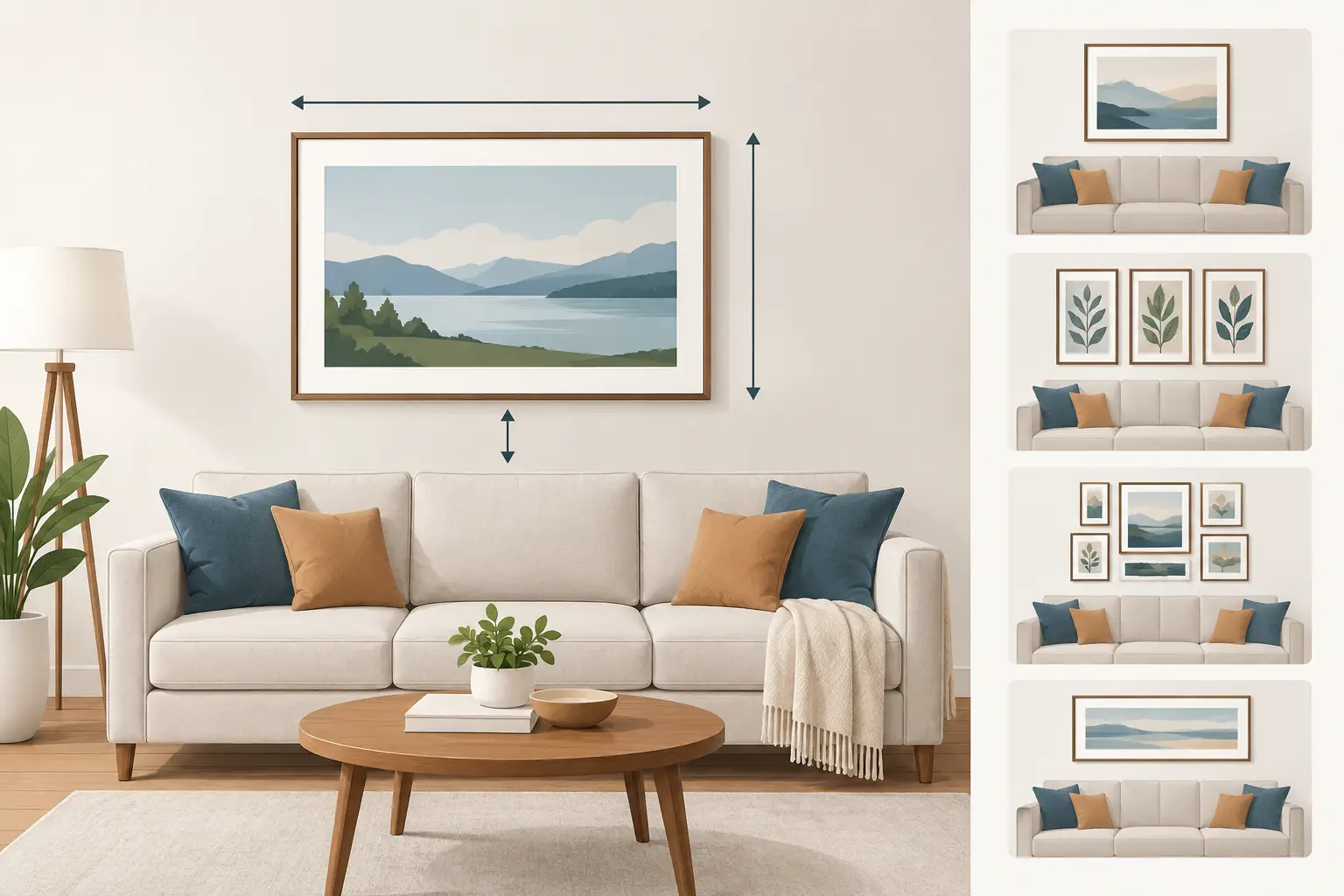
A sofa can be the biggest piece in the room, yet the empty wall above it is often where a living room feels unfinished. If you are asking what size picture above sofa will look right, the most useful starting point is not the size of a standard frame. It is the width of your sofa.
A picture that is too small can look like it has drifted up the wall on its own. One that is too wide may crowd the seating area and make the room feel top-heavy. The aim is a considered focal point: artwork that connects the sofa to the rest of the room, rather than simply filling a blank space.
What size picture above a sofa works best?
As a general rule, the artwork, or complete arrangement of artwork, should be around two-thirds to three-quarters the width of the sofa. This proportion is broad enough to look intentional without extending beyond the sofa’s visual footprint.
For example, above a 180 cm sofa, aim for a total display width of roughly 120 to 135 cm. That could be one large landscape picture, two matching framed prints side by side, or a compact gallery wall. Above a smaller two-seater around 140 cm wide, an arrangement measuring 95 to 105 cm across will usually feel well balanced.
This is a guide rather than a strict decorating law. A low, chunky sofa with deep arms can carry a slightly larger piece. A slim-legged sofa in a small lounge may look better with a lighter arrangement and more space around it. Look at the whole wall as well as the furniture below it.
Why sofa width matters more than wall width
It is tempting to choose art based on the full expanse of wall, especially in a newly decorated room. But the sofa and the picture need to read as one group. A tiny framed print centred on a very wide sofa can disappear, even if it seems perfectly reasonable against the wall alone.
The same principle works with a console table, sideboard or bed. Furniture provides the base line, while the art above it supplies height, colour and character. Keeping the display within the sofa’s width creates a calm, joined-up look.
How high should you hang a picture above a sofa?
Leave 15 to 25 cm between the top of the sofa and the bottom of the frame. This gap keeps the art close enough to feel connected to the furniture, while giving cushions and heads some breathing room when people are seated.
Pictures hung too high are one of the most common living-room mistakes. They can make even beautiful art seem detached from the room. If your sofa has a tall back or you have a picture rail, use your eye as well as the tape measure. The finished arrangement should sit in the comfortable zone between the sofa and ceiling, not hover near the top of the wall.
The traditional gallery rule is to place the centre of artwork at about 145 cm from the floor. Above a sofa, that can be adjusted slightly if needed. The gap above the furniture is usually the more helpful measurement, particularly with a large framed picture.
Choosing one picture, a pair or a gallery wall
The right format depends on the mood you want to create and the practical size of your available art.
One large statement picture
A single landscape-format picture is the simplest choice above a sofa. It works particularly well over a three-seater and brings a clear focal point to rooms with patterned rugs, colourful cushions or lots of smaller accessories already on show.
Choose an image with enough presence to hold the wall. A Constable landscape can add an open, restful feel, while a bold Picasso print gives a modern sofa sharper energy. Consider the frame as part of the overall size. A dark or substantial frame has greater visual weight than a narrow pale one, even where the measurements are identical.
Two or three matching framed prints
A pair of pictures can make a long sofa feel balanced without the cost or commitment of one oversized frame. Hang two same-sized framed prints with a gap of around 5 to 10 cm between them, then treat the outer edges as one complete display when checking the two-thirds rule.
Three pictures suit a wider wall or a sofa with a centred chaise. A row of coordinated Impressionist scenes, for example, has an easy rhythm and lets you bring several colours into the room without making it feel busy. Keep the spacing consistent. Uneven gaps are more noticeable than most people expect.
A compact gallery wall
A gallery wall is a good answer when you love smaller framed art, have a mix of favourite subjects, or want to build a display gradually. The important measurement is the outside edge of the whole group, not each individual frame.
Lay the arrangement on the floor first, or mark its outline on the wall with low-tack tape. Keep the gaps between frames at roughly 4 to 7 cm and make sure the overall display reaches at least two-thirds of the sofa width. Start with your largest or most colourful picture near the centre, then arrange smaller pieces around it.
A gallery wall need not be perfectly symmetrical. It does, however, need a shared thread. That might be black frames, warm cream mounts, British landscape scenes, dog portraits, or colours picked up from the curtains and cushions.
Can a small framed picture work above a sofa?
Yes, but it usually needs company. Compact ready-framed prints are excellent for making a pair, trio or gallery arrangement, especially in a first flat or a room where you want to spend carefully without settling for a bare wall.
A 10 x 13.5-inch framed print alone will generally look undersized above a standard three-seater. Use two in a horizontal pair, combine three in a row, or surround one central favourite with complementary smaller pieces. The result gives you more flexibility than one oversized image, and it is easy to update later.
At Stortvalley, framed fine art prints make this approach particularly straightforward: you can choose familiar artists and decorative subjects in display-ready formats, rather than trying to match separate prints and frames yourself.
Match the picture’s visual weight to the room
Measurements matter, but visual weight matters too. A pale watercolour with plenty of sky appears quieter than a richly coloured Lowry scene in a black frame. A royal portrait with a detailed gilt-style frame may feel larger and more formal than a similarly sized minimalist print.
In a neutral living room, one strong piece can give the sofa area a welcome lift. Pull one or two shades from the artwork into a cushion, throw or vase for a deliberate finish. In a room already full of colour, choose art with a calmer palette or a simple frame to stop the wall competing with everything else.
Think about viewing distance as well. A large, detailed painting needs enough room for its subject to be appreciated. For a compact lounge where the sofa is close to the wall opposite, smaller grouped prints can feel more comfortable than one vast, high-contrast image.
Measure before you make holes
Before hanging anything, measure the sofa width, the height of its back and the proposed art arrangement. Mark the left and right edges of the full display with tape, then stand back from the usual doorway and from the place where you sit. This quick check often reveals whether the arrangement needs another frame, a little more space, or a lower position.
Do not forget lamps, shelves and side tables. If a tall floor lamp sits beside the sofa, avoid making the picture display too wide on that side. A slightly off-centre arrangement can be the better choice when it balances the room as a whole.
Use suitable picture hooks and fixings for the wall type and the weight of your framed art. Once the picture is level, remove the tape and give yourself a moment to look at it in evening light too. The right picture size does more than cover the wall: it gives your sofa a setting, and makes the room feel like yours.