

Blog
How High to Hang Pictures for a Balanced Room

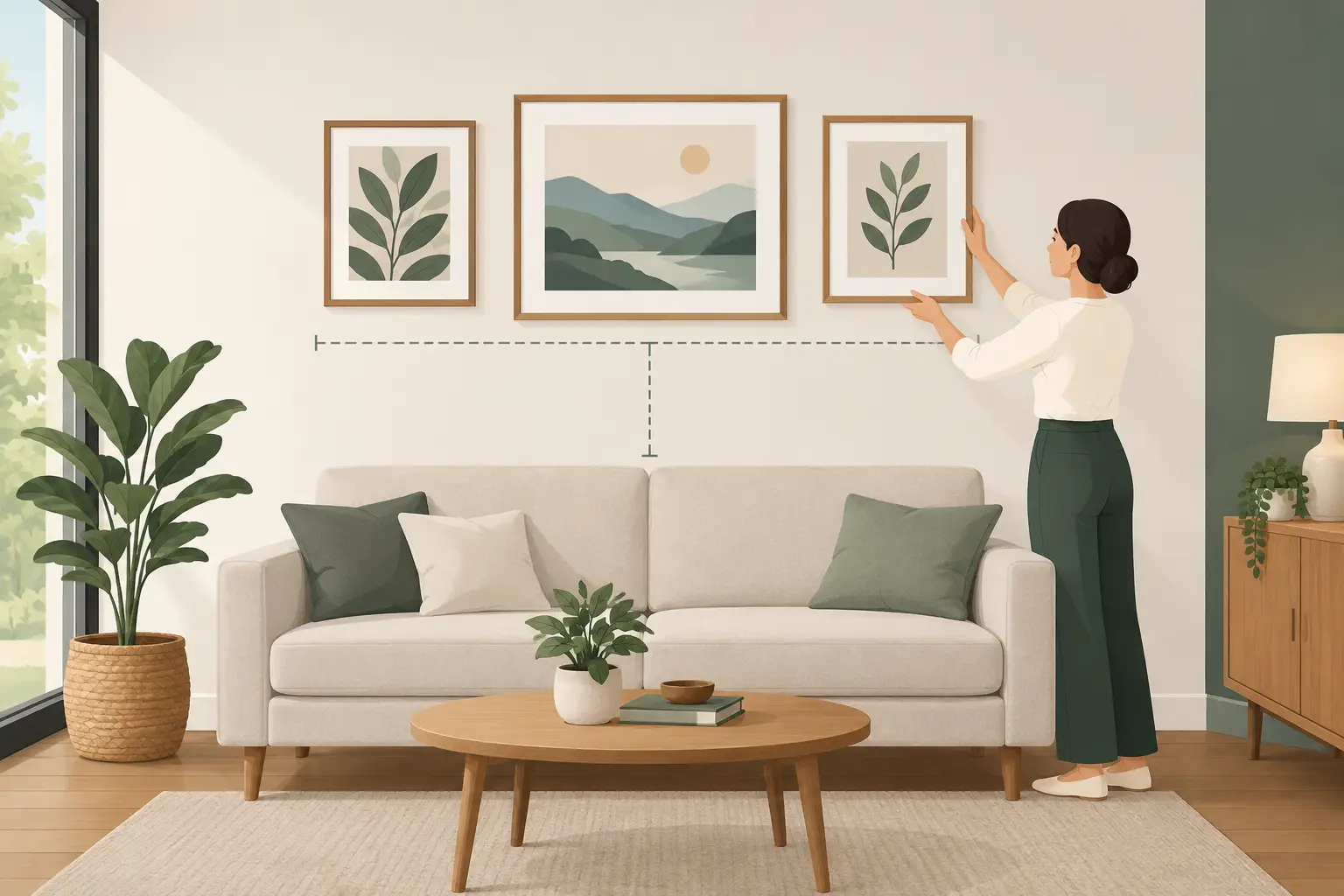
A beautiful framed print can still look slightly wrong if it is hung a few inches too high. It is one of the most common decorating mistakes, particularly in rooms with high ceilings or large stretches of blank wall. If you are wondering how high to hang pictures, start with the height of the artwork’s centre, then adjust for the furniture and the room around it.
The aim is not to make a wall look formally styled. It is to make the art feel connected to the people, furnishings and everyday life below it. Whether you are displaying a small Lowry scene in the hallway, a Van Gogh above the bed or a collection of favourite framed prints in the living room, a consistent approach makes the result feel considered.
The best general rule: hang art at eye level
For a picture on an otherwise empty wall, place the centre of the artwork around 145 cm from the floor. This is often called the 57-inch rule, and it is used by galleries because it puts the focal point of an artwork at a comfortable average viewing height.
Measure from the floor to the centre of the frame, not to its top edge. A compact framed print may therefore sit higher or lower than you expect when you first hold it against the wall. The centre is what matters, because it is where your eye naturally settles when looking at the image.
This guideline works particularly well in hallways, landings, dining rooms and uncluttered sections of a living-room wall. It is a useful starting point rather than a rigid law. In a home with very tall adults, you may prefer a little higher; in a cosy room with lower seating, slightly lower can look more natural.
A quick way to mark the right spot
First, measure the height of the framed picture and divide it by two. Add that figure to 145 cm to find the height of the frame’s top edge. Then check the fitting on the back of the frame. Because a wire or hook sits below the top of the frame, make a small allowance before putting in your picture hook.
It sounds fussy, but this extra minute avoids the familiar cycle of hanging, stepping back, moving the picture and filling the first hole. Use a pencil for a light, removable mark and ask someone to hold the frame in place if possible.
How high to hang pictures above furniture
When artwork hangs above a sofa, sideboard, bed, fireplace or desk, the furniture changes the rule. The picture should form part of one visual group with the piece below it, rather than floating in the upper half of the wall.
As a guide, leave roughly 15 to 25 cm between the bottom of the frame and the top of a sofa, headboard or sideboard. Above a mantelpiece, a smaller gap of around 8 to 15 cm usually works better. This keeps the art close enough to anchor the arrangement while leaving enough room for the frame to be seen clearly.
A picture over furniture can have its centre lower than 145 cm, and that is completely right. Hanging it at gallery height may place it too far above the sofa, making the room feel disjointed. Think of the sofa and the artwork as one composition, not as two separate decisions.
Width matters too. A single picture or group of pictures should usually occupy around two-thirds to three-quarters of the width of the furniture beneath it. Over a wide three-seater sofa, one very small frame can feel lost. A larger landscape print, a pair of complementary pictures or a neat gallery arrangement will have more presence.
Consider the room before you reach for the hooks
Ceiling height, wall shape and the way a room is used all affect placement. In a Victorian terrace with generous ceilings, it can be tempting to hang pictures high to fill the space. Usually, it is better to keep the main artwork at viewing height and use the empty area above as breathing room. Art placed close to the ceiling tends to make the room feel less inviting, not more impressive.
In a narrow hallway, pictures are often viewed while walking past rather than from a sofa. Keep them at roughly the 145 cm centre point, but make sure door frames, light switches and radiators do not interrupt the line. A run of small framed prints can look especially effective here when their centres align at one shared height.
For staircases, follow the angle of the stairs rather than trying to maintain one horizontal line. Keep the centre of each picture about 145 cm above the relevant stair tread. Before hanging, arrange the frames on the floor in the intended order, then use paper templates on the wall to test the climb of the arrangement.
Gallery walls need one clear line
Gallery walls look relaxed when they have an underlying structure. Without one, they can quickly become a collection of frames drifting across the wall. Choose an anchor: this might be the centre of the whole grouping at 145 cm from the floor, a straight bottom edge above a sideboard, or a central picture positioned first.
Keep the gaps between frames consistent. For small ready-framed prints, 5 to 8 cm is often enough to make the collection feel connected without becoming crowded. If you are mixing portrait and landscape formats, line up either the centres, the tops or the bottoms of selected frames. You do not need to align every edge, but the eye needs a repeated detail to follow.
A theme helps as well. You might pair French Impressionist scenes for soft colour and atmosphere, or combine expressive Picasso prints with simple black frames for a more graphic look. Mixing artists is welcome, but repeating one frame colour, a shared palette or a similar subject gives the wall a sense of purpose.
Try the paper-template method
Cut sheets of paper to match the outside dimensions of each frame and secure them with low-tack tape. Move them around until the group feels balanced from the main viewing point in the room. This is particularly useful above a bed or sofa, where the scale can be harder to judge from close up.
Take a photograph of the arrangement before you hang anything. Looking at it on your phone often reveals a picture that is too high, a gap that is too wide or a grouping that needs one stronger central image.
Hanging pictures above a bed
A bed creates a large visual block, so artwork needs to relate to its width and height. Hang framed pictures around 15 to 25 cm above the headboard, or use the same distance above the pillows if there is no headboard. A calm landscape, floral artwork or a gentle Constable scene can bring colour to the room without making it feel busy.
Avoid placing a very heavy frame directly above where you sleep unless it is fixed securely with suitable wall fittings. For plasterboard, masonry and stud walls, use hooks and fixings designed for the wall type and the weight of the frame. A glass-fronted framed print deserves a secure fixing, especially in busy family spaces.
If you are renting, picture rails, removable hooks rated for the appropriate weight, or a shelf-style ledge may be more practical. Always check the landlord’s rules before making holes in the wall.
When you should break the eye-level rule
Some spaces call for a different approach. Art above a tall fireplace may need to sit higher because the mantelpiece raises the whole arrangement. A large vertical print in a stairwell may be positioned to suit the architecture. In a child’s room, pictures hung closer to their eye level can make the space feel more personal and enjoyable.
Likewise, very small pictures sometimes look better as part of a cluster than alone at standard gallery height. A single compact framed print can be charming beside a reading chair, above a narrow console table or in an unexpected spot near a bookshelf. The key is to make the placement look intentional, not accidental.
Final checks before you call it finished
Stand where you will normally see the picture: seated on the sofa, entering the room or walking through the hall. Check that the frame is level, that it does not crowd a lamp or switch, and that its colours work with the nearby textiles and furniture. Natural daylight can make a blue-toned print look very different from warm evening lamplight, so look at it at more than one time of day.
Ready-framed art makes this process easier because the frame gives the image a finished edge from the start. A small, well-positioned print from Stortvalley can create just as much character as a larger piece that has been hung without regard for scale.
Trust the room as well as the measuring tape. When the artwork sits at a comfortable viewing height, relates to the furniture and gives the wall a clear focal point, it will feel as though it has always belonged there.